哎, 等待命运的裁决
-
Books related to big data to read:
- Big Data
- Big Data Revolution

-
Forward proxy
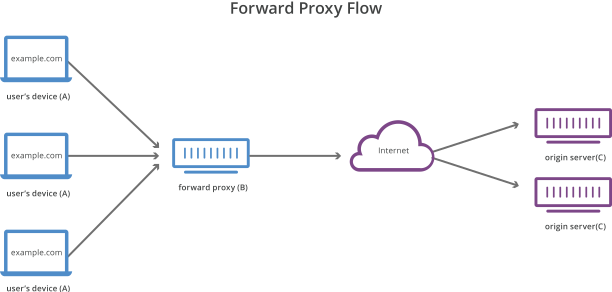
A forward proxy, often called a proxy, proxy server, or web proxy, is a server that sits in front of a group of client machines. When those computers make requests to sites and services on the Internet, the proxy server intercepts those requests and then communicates with web servers on behalf of those clients, like a middleman.
Why would anyone add this extra middleman to their Internet activity? There are a few reasons one might want to use a forward proxy:
- To avoid state or institutional browsing restrictions – Some governments, schools, and other organizations use firewalls to give their users access to a limited version of the Internet. A forward proxy can be used to get around these restrictions, as they let the user connect to the proxy rather than directly to the sites they are visiting.
- To block access to certain content – Conversely, proxies can also be set up to block a group of users from accessing certain sites. For example, a school network might be configured to connect to the web through a proxy which enables content filtering rules, refusing to forward responses from Facebook and other social media sites.
- To protect their identity online – In some cases, regular Internet users simply desire increased anonymity online, but in other cases, Internet users live in places where the government can impose serious consequences to political dissidents. Criticizing the government in a web forum or on social media can lead to fines or imprisonment for these users. If one of these dissidents uses a forward proxy to connect to a website where they post politically sensitive comments, the IP address used to post the comments will be harder to trace back to the dissident. Only the IP address of the proxy server will be visible.
Reverse proxy
A reverse proxy is a server that sits in front of one or more web servers, intercepting requests from clients. This is different from a forward proxy, where the proxy sits in front of the clients. With a reverse proxy, when clients send requests to the origin server of a website, those requests are intercepted at the network edge by the reverse proxy server. The reverse proxy server will then send requests to and receive responses from the origin server.
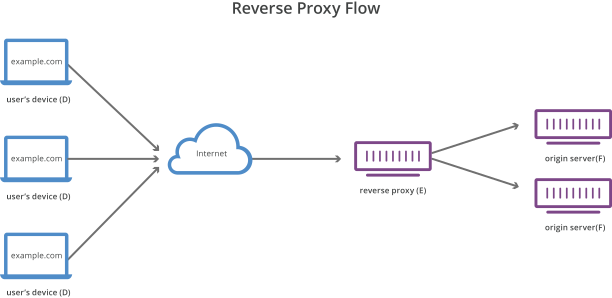
Below we outline some of the benefits of a reverse proxy:
- Load balancing – A popular website that gets millions of users every day may not be able to handle all of its incoming site traffic with a single origin server. Instead, the site can be distributed among a pool of different servers, all handling requests for the same site. In this case, a reverse proxy can provide a load balancing solution which will distribute the incoming traffic evenly among the different servers to prevent any single server from becoming overloaded. In the event that a server fails completely, other servers can step up to handle the traffic.
- Protection from attacks – With a reverse proxy in place, a web site or service never needs to reveal the IP address of their origin server(s). This makes it much harder for attackers to leverage a targeted attack against them, such as a DDoS attack. Instead the attackers will only be able to target the reverse proxy, such as Cloudflare’s CDN, which will have tighter security and more resources to fend off a cyber attack.
- Global Server Load Balancing (GSLB) – In this form of load balancing, a website can be distributed on several servers around the globe and the reverse proxy will send clients to the server that’s geographically closest to them. This decreases the distances that requests and responses need to travel, minimizing load times.
- Caching – A reverse proxy can also cache content, resulting in faster performance. For example, if a user in Paris visits a reverse-proxied website with web servers in Los Angeles, the user might actually connect to a local reverse proxy server in Paris, which will then have to communicate with an origin server in L.A. The proxy server can then cache (or temporarily save) the response data. Subsequent Parisian users who browse the site will then get the locally cached version from the Parisian reverse proxy server, resulting in much faster performance.
- SSL encryption – Encrypting and decrypting SSL (or TLS) communications for each client can be computationally expensive for an origin server. A reverse proxy can be configured to decrypt all incoming requests and encrypt all outgoing responses, freeing up valuable resources on the origin server.
-
AWS security models:
- CIA – Confidentiality, Integrity and Availability
- AAA – Authentication, Authorization and Accounting
- Non-repudiation
AWS is ISO27001, PCI-DSS certified
AWS compliance:
https://aws.amazon.com/compliance/Shared Responsibility Model
-
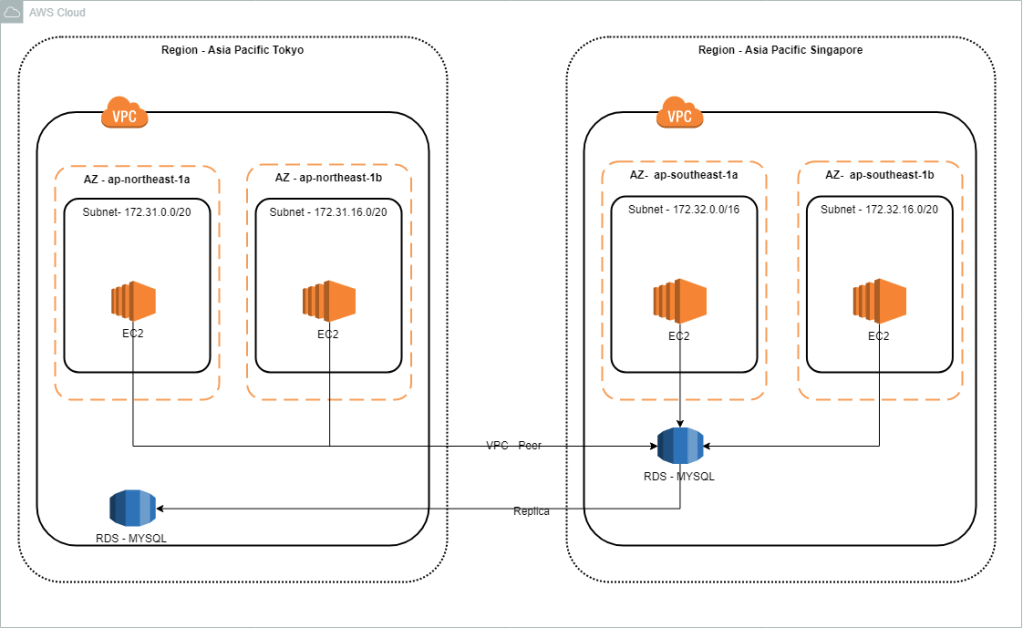
In this post, I would like to demo usage of AWS managed RDS, and how to setup Cross AZ and Cross region replication.
After that, I will test out the performance of this setup.
- Select Asia Pacific Singapore Region
- Create a new VPC and specify CIDR
- Create 2 subnet under:
- ap-southeast-1a
- ap-southeast-1b
- Create 2 EC2 instances under each subnet
- Create a RDS service – MYSQL, under this new VPC, and one of the subnet.
- Repeat the same setup in Asia Pacific Tokyo.
- Create a replica from RDS created in step 5.
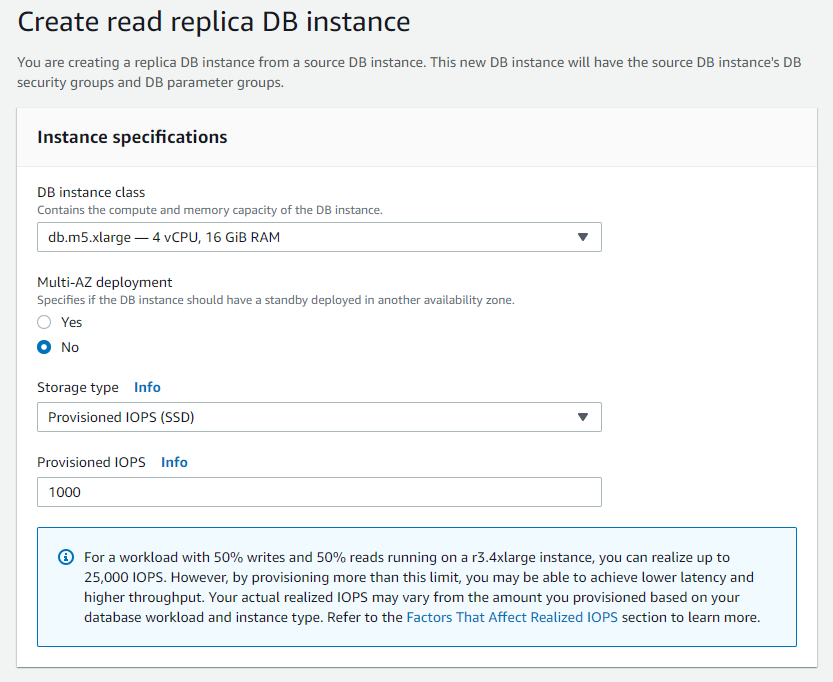
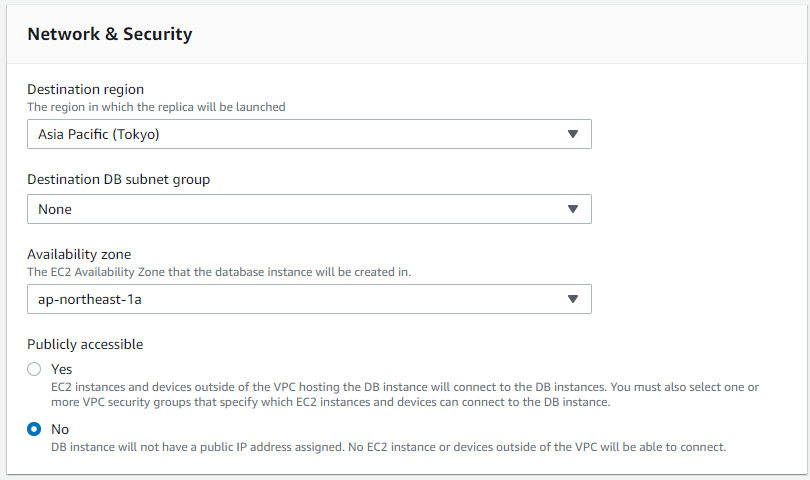
- You will hit an error here:
The parameter DBInstanceIdentifier must be provided and must not be blank. (Service: AmazonRDS; Status Code: 400; Error Code: InvalidParameterValue; Request ID: 1eab1af5-5e54-46ef-b059-ecf11edfce53)
- Now, we need to setup an encryption key in Tokyo VPC.
- Switch to Region Tokyo.
- Search for KMS server, inside, click on create key.
- Assign Key administrators as AWSServiceRoleForRDS
- Assign Key users as AWSServiceRoleForRDS
- Go back to Singapore Region, re-start the replica creation. In Encryption section, select Master key as the new key just created in Tokyo Region. Now it works.
- Now switch to Tokyo region and create same subnet and ec2 instances.
- After these steps, we have below setup and ready for some tests.
Will explain performance testing in next post.
-
上个星期五,出去给毛豆两个人打包肯德基,回来的时候,豆豆和我说,他大便了,姐姐帮他擦的屁股。顿时觉得毛毛又长大了!
最近豆豆总是踩我的小腿帮我按摩,棒棒滴小家伙!
毛毛于2019年完成两次读书的飞跃,一次是六月,一次是十二月。六月去香港买了一本纯英文文字的fairy tale书,回到四平老家一摆,一堆英文文字的书,于是开始读纯英文文字的书。十二月买了一堆米小圈带拼音的华文文字书,回到四平老家一摆,什么其他的都没有,毛毛也开始读上了。
最近一直给她讲我小时候最喜欢的郑渊洁魔方大厦的故事,昨天偶尔让她读一读,发现哇,可以基本上读百分之八九十了。
昨天买了小乐高给豆豆,结果不玩跑没影了,我本来以为买小了,结果我和毛毛一起摆,他也开始玩了,而且自己摆出了好几个,看来小孩子还是要push一下的。说起来惭愧,第一次陪孩子玩乐高,我也挺开心的:)
-
MySQL Group Replication
MGR – Single master
Master and Slave in different region deployment. It requires a maximum of 10ms network latency.otherwise, performance goes low more than 50%.
MGR – multi-master
multi-master supposed to apply in data segregation scenarios.AWS Cross Region replica
AWS supposes cross AZ db replication, as well as cross region backup.
Cross-Region backups are available in all AWS Regions that are available in AWS Backup except Asia Pacific (Hong Kong) and Middle East (Bahrain).
-

- CICD – Done
- cloudbees
- twist lock
- sonarqube
- Container – docker and k8s – Done
- spring application with docker setup in process
- pluralsight course: Docker and Kubernetes: The Big Picture
- Openshift
- Big data practice – in progress
- Cloudera
- ElasticSearch – ELK stack
- Dagster
- Ariflow
- Snowflake
- mango DB – pending
- spring application mongoDB
- Python – in progress
- NodeJS – in progress
- ReactJs – in progress
- AWS certification for Big Data – pending
- Machine Learning – on hold
- Andrew Ng course
- CICD – Done
-
毛毛问我,如果有一艘船,谁是船长?
我说,captain.
毛毛说,是如果。。。。
😰😰😰😰

-
最近居家隔离,毛毛有一次和我说奶奶不让她穿袜子,还说她神经病(不知道她是不是听错了。)我问她生不生气,她说不生气,我问为什么,她回答说:“因为奶奶是长辈。”当时我心里震动了,毛毛真心懂事啊!
今天又揍了豆豆一顿,不好好吃饭,带着姐姐两个人疯,当leader,还带着毛毛不好好吃饭,还把土豆丝撅我脸上,把他提到屋里用拳头一顿锤屁股,把我手都捶红了。第一次发现他眼睛里有恐惧的眼神,不知道是不是我太凶了。之后带着他们把我玩具收拾好了,然后让他自己吃饭,自己收玩具。自己收得还挺整齐的。
最近天天机器大发明,不是活面条做slime,就是屋子里满地水来玩水上飞;最近什么都要听他的,总想当leader,姐姐也当他的小助手。让他读个书我都要累吐血了,十五分钟我内耗很多啊,也自己反思,是不是我太着急了,是不是我方法不对,是不是我不够创新。总结:都不是,就是他不爱学习。有了培养毛毛的经验,我希望把他的他的双语阅读能力培养得更强!培养个儿子真是更不容易!用朋友的话说“脱胎换骨”!
接下来的居家隔离要继续整顿这个小伙子!
 Mao Mao Dou Dou